
Food
piçada: The Rustic Brazilian Flavor Tradition Revealed

Introduction
Food has a way of preserving memory. Long before blenders, packaged seasonings, and industrial sauces, people relied on their hands, stone tools, and instinct. In many Portuguese-speaking regions, especially in Brazil, the word piçada carries the echo of that older kitchen rhythm.It speaks of garlic crushed under pressure, herbs bruised to release fragrance, chilies broken open to awaken heat.It is not just a technique.It is a sensory act.
In modern kitchens, efficiency often replaces ritual. Yet the preparation known as piçada continues to survive because it produces something machines cannot fully replicate: depth of flavor shaped by friction, patience, and human touch. The act of crushing ingredients manually alters texture and aroma in a way that blending or slicing does not.
To understand piçada is to understand a philosophy of cooking rooted in simplicity and intensity. It is about coaxing flavor rather than forcing it. It is about respecting ingredients by transforming them slowly, deliberately, and with awareness.
What Is piçada
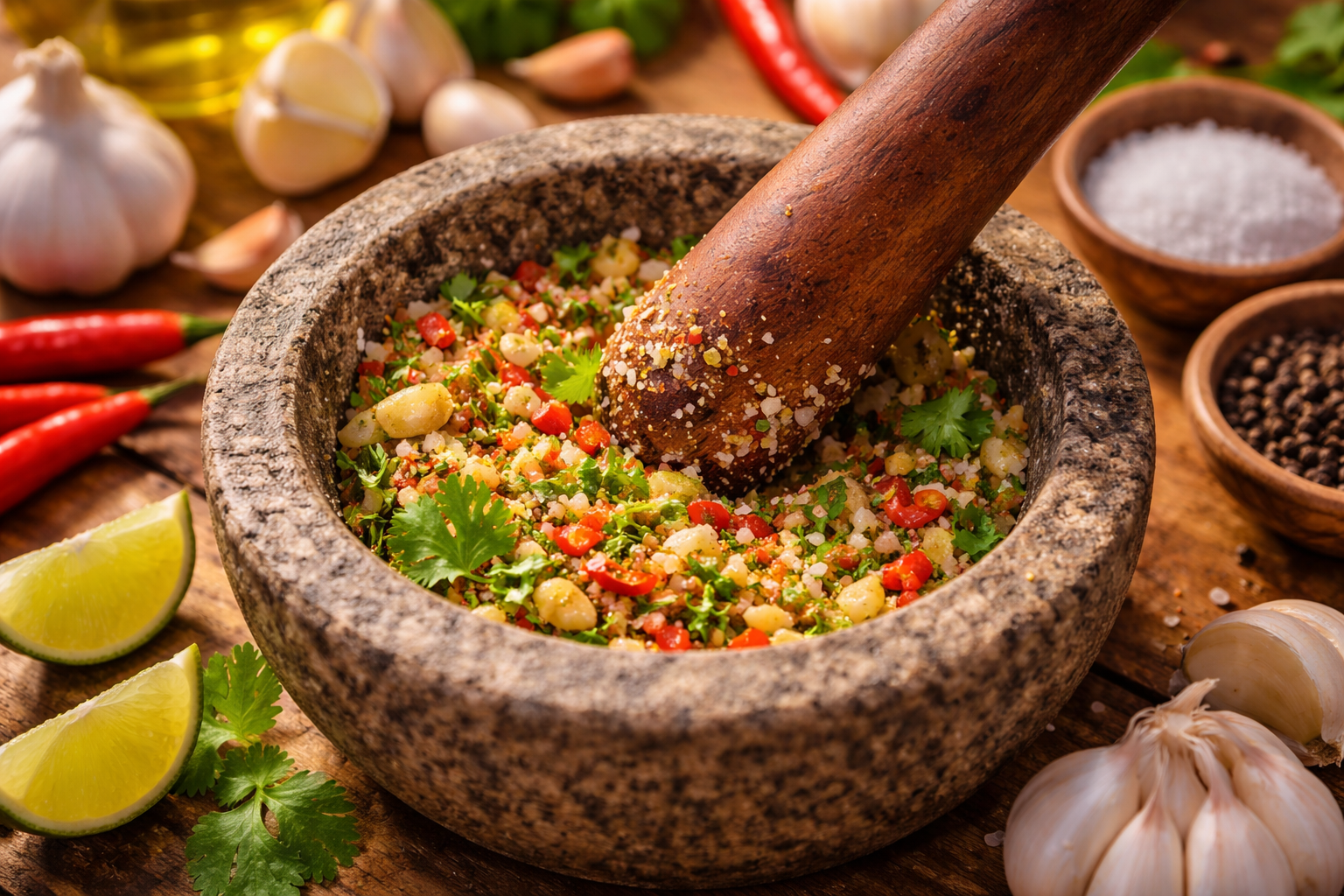
Piçada refers to a preparation made by crushing or pounding ingredients, traditionally using a mortar and pestle. The word comes from Portuguese linguistic roots associated with pressing, grinding, or pounding. In culinary contexts, piçada most commonly describes a mixture of garlic, salt, herbs, and sometimes chili or oil that has been manually crushed to create a rustic seasoning base.
Unlike finely blended sauces, a piçada retains texture. Tiny fragments of garlic remain visible. Herbs are bruised rather than liquefied. Salt crystals help break down cell walls, releasing essential oils and natural juices. The result is not a smooth paste but a coarse, aromatic mixture that clings beautifully to meats, seafood, or vegetables.
In Brazilian cooking, piçada often forms the foundation of marinades and flavor bases. It may be rubbed onto grilled meats before they hit the fire or stirred into stews to deepen complexity. The simplicity of the ingredients is deceptive. The power lies in how they are treated.
The Technique Behind the Flavor
What separates a piçada from ordinary chopped seasoning is the mechanical action involved. Crushing ingredients with a pestle does more than break them into smaller pieces. It ruptures plant cells more thoroughly than slicing. When garlic is crushed rather than cut, it releases more allicin, the compound responsible for its pungency and depth.
The texture matters. When herbs are pounded, their essential oils bloom under pressure. The friction between salt and fresh leaves intensifies aroma. Chili peppers, when crushed, release both heat and subtle fruitiness.
This technique creates a layered flavor experience. Instead of isolated tastes, the ingredients merge organically. Each component contributes while still maintaining individuality. A piçada does not aim for uniformity. It embraces rustic texture as part of its character.
Cultural Roots in Brazilian Kitchens
Brazil’s culinary identity is shaped by Indigenous traditions, Portuguese colonial influence, and African heritage. The method behind piçada reflects this blending of cultures. Indigenous communities used stone tools long before European contact. Portuguese settlers introduced garlic-heavy cooking styles. African influences contributed bold seasoning techniques and spice integration.
In rural Brazilian households, preparing a piçada is often part of daily routine. It may begin the cooking process before dawn, especially in farming communities. Garlic and salt are crushed first, forming a base. Fresh herbs such as parsley or cilantro might be added next. Some regions include lime zest or a splash of oil.
Because Brazil is geographically vast, regional interpretations vary. Coastal areas may incorporate citrus and seafood elements. Inland regions may favor stronger garlic-forward mixtures to accompany grilled beef. Yet across these differences, the essence of piçada remains consistent: manually crushed flavor built from fresh ingredients.
Texture, Aroma, and Sensory Experience
Modern food culture often prioritizes visual smoothness and uniformity. However, piçada resists that aesthetic. Its coarse texture signals authenticity. When spread over meat or stirred into rice, it leaves visible traces of crushed herbs and garlic fragments.
The aroma of a freshly prepared piçada is immediate and vibrant. There is a sharpness from garlic, a green brightness from herbs, and sometimes a lingering heat from chili. Unlike bottled seasonings, which can taste flat or overly processed, this mixture carries freshness that feels alive.
The sensory power extends beyond smell and taste. The act of crushing ingredients creates a rhythmic sound in the kitchen. The mortar echoes softly as the pestle presses and twists. It is a tactile experience. The cook feels resistance from garlic cloves and hears the subtle cracking of salt crystals. Cooking becomes physical rather than purely mechanical.
piçada as a Marinade Base
One of the most common uses of piçada is as a marinade for meats. When rubbed onto beef, chicken, or pork, the crushed mixture penetrates more effectively than simple chopped seasoning. The natural juices released during crushing help the flavors adhere to protein surfaces.
In Brazilian barbecue culture, known as churrasco, a piçada may be applied shortly before grilling. The salt draws moisture slightly to the surface, forming a flavorful crust when exposed to high heat. Garlic caramelizes gently, adding sweetness to its natural sharpness.
The beauty of this preparation lies in its balance. It enhances rather than overwhelms. Even when simple, a well-made piçada transforms plain cuts of meat into something layered and memorable.
Regional Variations and Ingredient Creativity
Although garlic and salt are foundational, variations of piçada reflect local ingredient availability. In some regions, cooks add fresh oregano or bay leaves. In others, green onions or chili peppers are incorporated for brightness and heat.
Certain interpretations lean toward acidity. A squeeze of lime or splash of vinegar may be added after crushing to create a slightly tangy mixture. This variation pairs particularly well with seafood.
There are also oil-enriched versions where olive oil or vegetable oil is folded into the crushed mixture to create a looser consistency. This type can be drizzled over roasted vegetables or used as a finishing sauce.
Despite these differences, the defining feature remains the manual crushing technique. That is what makes the mixture a true piçada rather than simply a chopped seasoning blend.
The Science of Crushing Versus Blending
From a culinary science perspective, crushing ingredients manually alters their chemical release patterns. When garlic is blended in a machine, heat from friction can dull certain volatile compounds. Crushing by hand generates less heat, preserving delicate aromas.
Herbs, when finely blended, may oxidize quickly and lose color. In a piçada, the larger fragments retain structure and freshness for longer. The salt used during crushing acts both as seasoning and as an abrasive agent, breaking down fibers while stabilizing flavor.
This subtle difference affects taste perception. The flavor profile of a piçada feels more rounded and less aggressive than heavily processed alternatives. It demonstrates how technique influences outcome as much as ingredient quality does.
Modern Adaptations in Contemporary Cooking
As global cuisine evolves, chefs have begun incorporating traditional techniques into modern presentations. Piçada has found its way into upscale restaurants where chefs reinterpret rustic methods with refined plating.
Some chefs use it as a finishing touch on grilled vegetables, spreading it lightly over charred eggplant or zucchini. Others incorporate it into compound butters, blending the crushed mixture into softened butter to melt over steak.
Even in urban kitchens with modern appliances, many cooks return to the mortar and pestle when preparing piçada. There is something grounding about the manual act. It reconnects cooking to its origins.
At the same time, contemporary home cooks experiment with fusion variations, adding ingredients like smoked paprika, lemon zest, or roasted garlic. While these interpretations expand the flavor spectrum, they retain the core principle of crushing fresh components together.
Nutritional Perspective
Because piçada is built from fresh garlic, herbs, and minimal added fats, it offers nutritional advantages compared to processed sauces. Garlic contains compounds associated with immune support and cardiovascular health. Fresh herbs provide antioxidants and micronutrients.
The absence of preservatives and artificial additives makes it appealing to those seeking natural cooking methods. When used as a seasoning base, it reduces the need for heavy sauces high in sugar or sodium.
However, balance remains important. The salt content should be controlled, especially when used frequently. The beauty of piçada lies in simplicity, not excess.
Symbolism of Manual Preparation
Beyond flavor, piçada symbolizes an approach to cooking that values effort and patience. The act of crushing ingredients is deliberate. It cannot be rushed. The cook must feel when the garlic has softened, when the herbs have released enough aroma.
In a world increasingly dominated by speed, this method encourages slowing down. It transforms preparation into ritual. Many families pass down the technique informally, teaching younger generations not only the recipe but the rhythm.
This connection between food and memory is powerful. A familiar aroma of crushed garlic and herbs can instantly evoke home kitchens and shared meals. In that sense, piçada becomes more than a seasoning. It becomes an emotional anchor.
Conclusion
Piçada represents a culinary tradition rooted in texture, aroma, and mindful preparation. At its core, it is a simple mixture of crushed ingredients. Yet the technique behind it transforms ordinary components into something deeply expressive.
From rural Brazilian kitchens to contemporary dining tables, piçada continues to prove that flavor does not require complexity. It requires attention. By crushing garlic, herbs, and salt together, cooks unlock intensity while preserving freshness.
Its enduring appeal lies in its honesty. There is no artificial smoothness, no hidden processing. Just real ingredients, manually transformed. In every coarse spoonful, piçada carries history, culture, and the unmistakable depth that comes from human touch.
FAQs
What ingredients are typically used in piçada?
Piçada usually includes garlic and salt as a base, often combined with fresh herbs such as parsley or cilantro. Some variations include chili peppers, lime juice, or oil.
Is piçada the same as a sauce?
Not exactly. While it can function as a marinade or seasoning paste, piçada is coarser than most sauces and retains visible texture from crushed ingredients.
Can piçada be made without a mortar and pestle?
It can be approximated with a knife, but the traditional texture and flavor are best achieved through manual crushing in a mortar and pestle.
How is piçada commonly used in cooking?
It is frequently rubbed onto meats before grilling, stirred into stews, or added to vegetables to enhance flavor.
Does piçada have regional variations?
Yes. Different regions adapt the basic preparation by incorporating local herbs, citrus elements, or chili peppers, while maintaining the essential crushing technique.
Introduction
In the vast and ever-evolving world of gastronomy, some words vanish before they ever gain recognition. They flicker briefly in specialized kitchens, in regional dialects, or in the quiet margins of culinary experimentation. One such word is calamariere. At first glance, it sounds Italian, perhaps connected to seafood, or something poetic and old-world. Yet its rarity is precisely what makes it compelling.
Food culture thrives on naming. The names we give to techniques, roles, or creations often shape how they are understood and preserved. When a term like calamariere emerges—whether rooted in tradition, regional practice, or modern reinterpretation—it deserves thoughtful exploration rather than casual dismissal. Culinary language has always evolved alongside taste, trade, and craftsmanship. Sometimes a term signals not just a dish, but an entire approach to preparing it.
This article takes a deep and careful look at calamariere as a culinary concept, exploring its linguistic roots, its connection to seafood preparation, its relevance in modern kitchens, and why such niche terminology matters in today’s food landscape.
What Is Calamariere
Calamariere refers to a specialized culinary role or technique centered around the preparation, handling, and presentation of squid and related cephalopods in refined cuisine. While not widely standardized in global culinary dictionaries, the structure of the word suggests Italian roots. “Calamari” is the well-known Italian term for squid, and the suffix evokes professional designation, much like “pasticciere” for pastry chef.
In this interpretation, a calamariere is a chef or culinary artisan who has developed deep expertise in squid preparation. This is not simply someone who fries rings of calamari. It suggests a higher level of mastery—understanding texture control, ink usage, regional traditions, preservation methods, and modern plating styles. In professional kitchens where specialization is valued, such roles can exist informally even if the title is rarely written on a uniform.
More broadly, calamariere can also describe a refined technique of working with squid, emphasizing precision cutting, marination science, tenderization, and balanced flavor pairing. In this sense, the word represents craftsmanship rather than just occupation.
Linguistic Roots and Cultural Context
The structure of calamariere reflects a tradition in Romance languages where culinary roles are identified by their area of expertise. In Italian culinary heritage, titles carry prestige and communicate skill. Words like “sommelier” in French or “charcutiere” carry both technical and cultural weight.
The emergence of calamariere, whether historically regional or more contemporary in culinary circles, reflects a long Mediterranean relationship with squid. Coastal regions of Italy, Spain, and Greece have treated squid not as casual seafood but as an ingredient demanding respect. Its delicate muscle fibers, ink sacs, and rapid spoilage rate require skillful handling.
If we consider the culinary evolution of seafood, squid has transitioned from a humble fisherman’s catch to a centerpiece in fine dining. As cuisine grows more specialized, it becomes logical that a term like calamariere could arise to acknowledge deep expertise in cephalopod cookery.
The Culinary Complexity of Squid
Understanding calamariere requires understanding squid itself. Squid is deceptively simple. It cooks quickly, yet if mishandled, it becomes rubbery and unpalatable. There is a narrow window between tender and tough, and mastering that window separates amateurs from experts.
A calamariere would understand the dual nature of squid cooking: it must either be cooked very quickly at high heat or braised gently for extended periods. Anything in between risks ruining texture. This level of precision demands not just practice but scientific awareness of protein contraction and moisture retention.
Beyond texture, squid offers multiple culinary components. The body, tentacles, ink, and even cartilage-like quill each have potential uses. Ink can deepen sauces, enrich pasta, and add dramatic visual contrast. The body can be stuffed, sliced into ribbons, or scored to create aesthetic patterns when seared. This depth of application justifies a dedicated focus that the term calamariere implies.
Historical Seafood Specialization
Seafood specialization is not new. In many coastal communities, certain cooks became known for preparing specific catches better than anyone else. In Mediterranean fishing towns, the morning’s catch determined the day’s cooking expertise.
Although the word calamariere may not appear in ancient manuscripts, the role it suggests certainly existed. Historical records from Southern Italy and Sicily reveal highly specific methods for preparing squid stews, stuffed calamari, and ink-based sauces. These recipes required generational knowledge.
Modern culinary institutions often emphasize broad training. However, older traditions valued hyper-specialization. A calamariere, conceptually, represents this older philosophy—deep mastery over a single ingredient.
Techniques That Define a Calamariere
The skill set implied by calamariere goes beyond frying. It involves understanding sourcing. Fresh squid must smell clean, not fishy. Its skin should shimmer slightly. The eyes must remain clear. Identifying freshness is foundational.
Cleaning is another delicate step. Removing the ink sac without rupturing it requires steady hands. Separating the head and body, peeling thin outer membranes, and extracting the quill must be done efficiently to preserve texture.
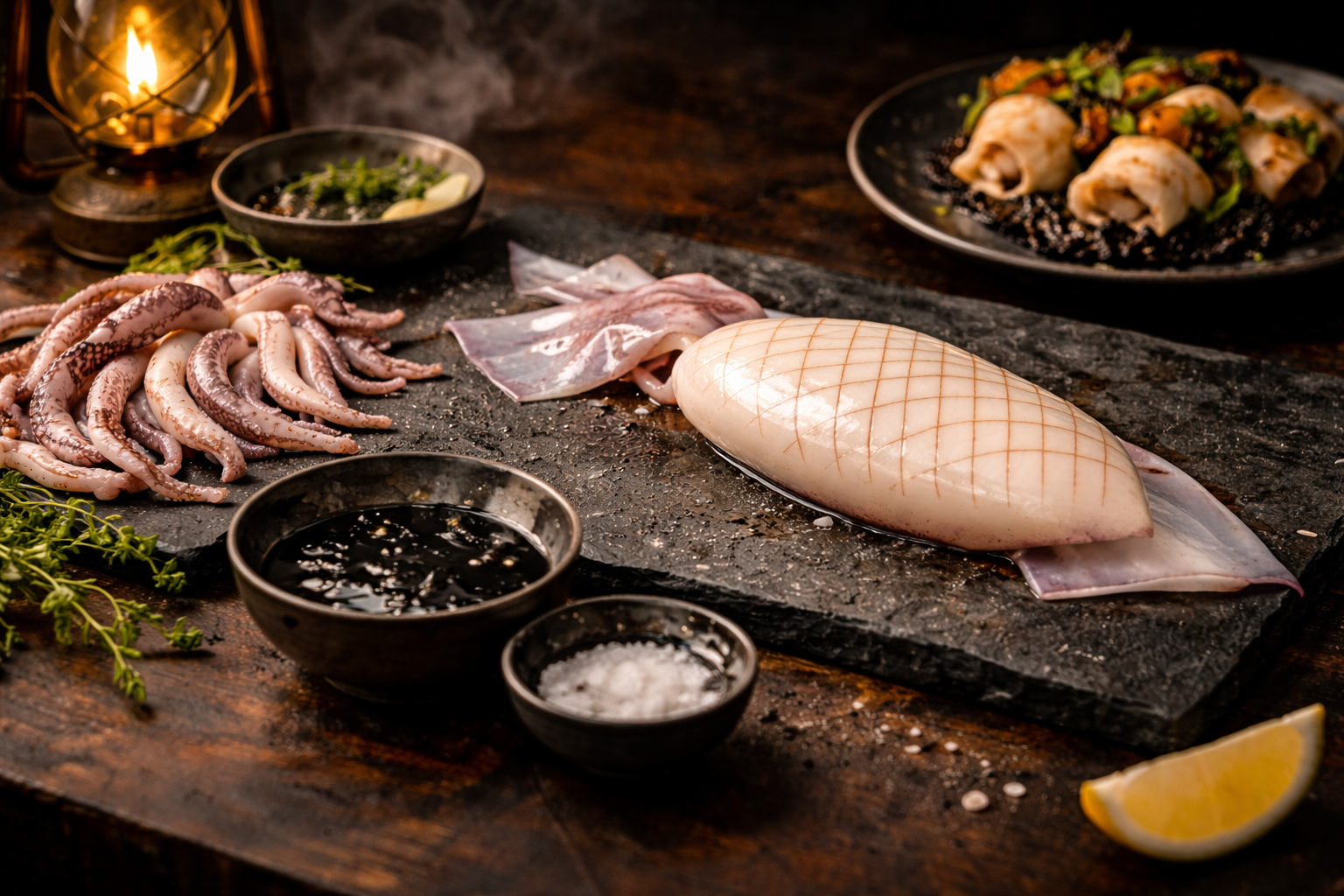
Then comes preparation. Scoring the body in a crosshatch pattern prevents curling during cooking. Light marination with citrus must be timed carefully to avoid over-curing the flesh. Quick grilling demands high heat and seconds of precision. Slow braising requires balanced acidity to prevent toughness.
A true calamariere would also understand global variations. Japanese ika sashimi preparation, Spanish calamares en su tinta, and Italian stuffed calamari each reflect different philosophies. Mastery involves respecting tradition while adapting to modern plating aesthetics.
The Modern Revival of Ingredient-Focused Mastery
Today’s culinary world often celebrates innovation. Foam, molecular gastronomy, and cross-cultural fusion dominate high-end restaurants. Yet there is a growing counter-movement that values ingredient integrity over spectacle.
In this environment, the concept of calamariere feels increasingly relevant. Diners are curious about sourcing, sustainability, and technique transparency. A chef who dedicates serious attention to squid preparation aligns with this deeper appreciation of craft.
Sustainability also plays a role. Squid populations, when managed properly, can be a more environmentally resilient seafood option compared to overfished species. A calamariere would not only focus on technique but also responsible sourcing.
Texture, Flavor, and Artistic Presentation
One of the most fascinating aspects of squid is its ability to absorb flavor while maintaining its marine identity. It pairs beautifully with garlic, lemon, chili, tomato, and herbs. It also holds up against bold sauces and smoky grilling.
The calamariere approach would treat plating as part of the craft. Squid ink creates dramatic black pasta or velvety sauces. Thinly sliced tentacles can add visual intrigue. Light charring creates contrast against vibrant greens or bright citrus segments.
Presentation is not vanity; it shapes perception. The visual drama of ink against white porcelain invites anticipation. The tender bite confirms expertise. Craft becomes visible.
Why Terminology Like Calamariere Matters
Language influences perception. When a role or technique has a name, it gains legitimacy. The word calamariere, even if rare, highlights the importance of recognizing culinary specialization.
In professional kitchens, titles can shape hierarchy and training pathways. A cook striving to become a calamariere would pursue focused experience rather than broad generalization. This depth fosters excellence.
Culturally, preserving niche culinary terms protects diversity. Globalization can flatten cuisine into standardized menus. Unique terminology resists that flattening. It preserves nuance.
Calamariere in Contemporary Dining Culture
Contemporary dining culture values storytelling. Guests want to know where ingredients come from and how they are treated. A restaurant highlighting a calamariere-style approach communicates seriousness about seafood preparation.
In tasting menus, squid often appears as a refined course rather than casual appetizer. Chefs who elevate squid beyond fried rings demonstrate technical authority. The term calamariere encapsulates that elevation.
Food media increasingly celebrates chefs with hyper-specific passions. Fermentation experts, bread artisans, and chocolate specialists gain recognition. Within this landscape, a calamariere represents the seafood equivalent of such focused mastery.
Conclusion
Calamariere may not yet appear in mainstream culinary dictionaries, but the concept it represents is deeply rooted in tradition and increasingly relevant today. It symbolizes dedication to ingredient mastery, respect for technique, and appreciation for seafood complexity.
In a world where culinary trends rise and fall quickly, specialization offers stability. Squid, often underestimated, demands precision and rewards patience. The calamariere embodies that patience. Through careful sourcing, meticulous cleaning, controlled cooking, and thoughtful presentation, this role transforms a simple marine creature into a refined culinary experience.
Ultimately, whether widely adopted or quietly practiced, the idea of calamariere reminds us that true craftsmanship lies not in doing everything, but in doing one thing exceptionally well.
FAQs
What does calamariere mean in culinary terms?
Calamariere refers to a specialized culinary role or technique focused on the expert preparation and presentation of squid and related seafood.
Is calamariere an official chef title?
It is not widely standardized in global culinary institutions, but it reflects a conceptual specialization similar to other traditional culinary roles.
Why is squid difficult to cook properly?
Squid becomes tough if cooked for too long at moderate heat. It must either be cooked very quickly or braised slowly to maintain tenderness.
Does calamariere involve sustainability awareness?
Yes, a true calamariere approach would include responsible sourcing and understanding of sustainable seafood practices.
How is calamariere different from simply cooking calamari?
Cooking calamari can be basic, but calamariere implies deep expertise, refined technique, artistic presentation, and comprehensive knowledge of squid as an ingredient.
In the ever-evolving world of business, finding the right tools and strategies to enhance productivity, streamline operations, and drive growth is crucial. One such tool that has been gaining attention in 2025 is Pravi Celer. But what exactly is it, and why are entrepreneurs and small business owners rushing to implement it in their operations?
In this article, we’ll uncover what Pravi Celer is, why it’s important in 2025, and how you can integrate it into your business. By the end of this post, you’ll understand the profound impact Pravi Celer can have on your entrepreneurial journey.
What Is Pravi Celer?
At its core, Pravi Celer is a business optimization tool designed to help entrepreneurs and small business owners streamline their operations, improve decision-making, and boost overall efficiency. By harnessing data analytics, automation, and AI-driven insights, it enables businesses to make smarter, faster decisions in a competitive environment.
Why Pravi Celer Matters in 2025
As we move further into 2025, businesses are facing unprecedented challenges. Economic fluctuations, evolving customer expectations, and the rise of AI and automation are all influencing business dynamics.
Pravi Celer offers a solution to these challenges by providing businesses with the agility needed to stay ahead. In a world where digital transformation is no longer optional, this tool helps businesses adapt and thrive.
By using real-time data analytics, Pravi Celer ensures that businesses don’t just survive—they excel. Its ability to automate routine tasks and offer predictive insights gives entrepreneurs the edge they need to make proactive, not reactive, decisions.
How to Implement Pravi Celer in Your Business
Step 1: Understand Your Business Needs
Before diving into any tool, understanding your business needs is crucial. What are the primary pain points you want to address? Is it improving customer satisfaction, optimizing workflow, or enhancing inventory management? Identifying these areas will help you use Pravi Celer to its full potential.
Step 2: Integrate Data Analytics
The heart of Pravi Celer is its data analytics capability. Once you’ve identified your focus areas, begin integrating your existing data sources with the tool. This could include sales data, customer feedback, or operational insights. The more comprehensive the data, the more powerful the insights you can gain.
Step 3: Automate Routine Processes
One of the standout features of Pravi Celer is its automation capabilities. By automating repetitive tasks such as scheduling, reporting, and customer communication, you can free up valuable time for strategic decision-making. This also reduces the risk of human error, ensuring smoother operations.
Step 4: Leverage AI-Driven Insights
Once data is integrated and tasks are automated, the next step is leveraging AI-driven insights. Pravi Celer uses machine learning algorithms to analyze trends, predict customer behavior, and identify new opportunities. These insights can guide your next move—whether it’s launching a new product, expanding to a new market, or optimizing your marketing strategy.
Tools and Strategies Involved with Pravi Celer
Pravi Celer is not just about one tool—it’s about creating a comprehensive system that works in harmony. Key strategies involved include:
- Predictive Analytics: Using data to forecast future trends and outcomes.
- AI-Powered Automation: Automating administrative tasks to improve efficiency.
- Customer Relationship Management (CRM): Enhancing customer satisfaction and loyalty through personalized communication.
- Supply Chain Optimization: Improving logistics and inventory management for cost efficiency.
Common Mistakes and How to Avoid Them
As with any tool, there are common pitfalls businesses should be aware of when using Pravi Celer. Here are a few mistakes to avoid:
- Ignoring Data Quality: Inaccurate or incomplete data can lead to flawed insights. Ensure that the data you feed into Pravi Celer is reliable and up to date.
- Over-Automating: While automation is a powerful tool, it’s essential to maintain a human touch in customer interactions. Over-reliance on automation can hurt customer relations.
- Lack of Training: Pravi Celer’s full potential can only be realized when the team is trained to use it effectively. Don’t skip the training phase!
Case Studies and Data Insights
Let’s take a look at a case study. XYZ Corp., a small retail business, implemented Pravi Celer to streamline its operations and enhance customer engagement. After integrating data analytics and automation, the company saw a 30% reduction in operational costs within the first six months. Customer satisfaction also improved significantly due to the personalized communication powered by AI.
This case highlights how Pravi Celer can lead to tangible improvements when used strategically. The key takeaway here is that businesses that integrate data, automation, and AI into their operations can not only survive but thrive in 2025’s competitive landscape.
Benefits of Pravi Celer
- Increased Efficiency: Automation of routine tasks frees up time for high-level strategic planning.
- Smarter Decisions: AI-driven insights help businesses make data-backed, informed decisions.
- Cost Reduction: By optimizing operations, businesses can reduce overhead costs, boosting profitability.
- Improved Customer Experience: With CRM features and personalized communication, customer satisfaction increases, leading to higher retention rates.
Challenges of Pravi Celer
- Learning Curve: The initial setup and integration of the system can be challenging for some businesses.
- Data Dependency: The quality of insights depends on the quality of data fed into the system.
- Upfront Costs: Implementing a comprehensive system like Pravi Celer can require a significant upfront investment, which may be a barrier for some businesses.
Future Trends: What’s Next for Pravi Celer?
Looking ahead, Pravi Celer is set to evolve with advancements in artificial intelligence and machine learning. The integration of even more powerful analytics tools and greater automation capabilities will make it an even more essential tool for businesses in the years to come.
Expect improvements in predictive analytics—allowing businesses to forecast customer trends and inventory needs with pinpoint accuracy. Moreover, the future of Pravi Celer will likely see even deeper integration with cloud platforms and IoT systems, further enhancing its capabilities.
FAQs
1. How does Pravi Celer help improve my business operations?
Pravi Celer helps improve operations by automating routine tasks, providing predictive insights, and optimizing decision-making through data analytics.
2. Can Pravi Celer be integrated with my existing CRM system?
Yes, Pravi Celer can be integrated with most major CRM systems to enhance customer management and communication.
3. Is Pravi Celer suitable for small businesses?
Absolutely! Pravi Celer is designed to scale with businesses of all sizes, providing solutions that are both affordable and effective for small business owners.
4. What industries can benefit from Pravi Celer?
Pravi Celer is versatile and can benefit a wide range of industries, including retail, hospitality, healthcare, and professional services.
Conclusion: Embrace the Future with Pravi Celer
In 2025, business success hinges on adaptability, data-driven decisions, and streamlined operations. Pravi Celer offers the tools to help you achieve just that. Whether you’re looking to automate processes, enhance customer satisfaction, or optimize operations, Pravi Celer has got you covered.

Are you ready to elevate your dining adventures? Welcome to iamrestaurant.com, your go-to destination for discovering top-rated eateries, making reservations, and grabbing exclusive deals. By combining real-time updates, robust reviews, and user-friendly booking tools, this platform revolutionizes how food lovers explore the culinary world.
1. What Makes iamrestaurant.com Stand Out
iamrestaurant.com shines through its seamless interface and comprehensive features. Not only does it offer a vast directory of restaurants, but it also provides:
- Real-time availability updates, ensuring you see open tables before making a reservation
- User-generated reviews and ratings, adding transparency and trust
- Exclusive deals and loyalty perks, rewarding you for dining
Consequently, whether you’re hunting for a hidden gem or booking a popular hotspot, iamrestaurant.com delivers convenience and peace of mind.
2. Deep Dive: Key Features of iamrestaurant.com
2.1 Real-Time Availability and Reservations
With an intuitive booking system, iamrestaurant.com displays live table availability. Therefore, you can effortlessly reserve a table at your preferred time without calling the restaurant.
2.2 Community Reviews and Ratings
Each listing features authentic feedback from fellow diners. Because iamrestaurant.com incentivizes honest reviews, you get valuable insights into food quality, service, and ambiance before choosing where to dine.
“The atmosphere was amazing and the staff were super friendly,” wrote a guest after visiting a newly listed café.
2.3 Special Deals and Loyalty Programs
Notably, members can unlock exclusive deals—ranging from complimentary appetizers to bundled meal discounts. Besides, loyalty programs enable you to earn points with every visit.
3. How to Use iamrestaurant.com Like a Pro
The platform’s interface keeps navigation simple. To maximize your experience, follow these steps:
- Search by location or cuisine to filter options based on your mood.
- Check real-time table availability and select a time slot that fits your schedule.
- Reserve your table with just a few clicks—no phone call needed.
- Arrive and enjoy your meal, knowing your reservation is confirmed.
- Leave a review after dining to help the community and earn loyalty rewards.
4. Why Active Diners Love iamrestaurant.com
4.1 Unmatched Convenience
Rather than spending hours on calling multiple restaurants, iamrestaurant.com simplifies the process into an efficient, online booking flow. Hence, users save both time and effort.
4.2 Increased Transparency and Trust
Because reviews are community-driven and reservation updates are real-time, the platform builds trust. Additionally, verified reviews and accurate availability reduce chances of disappointment.
4.3 Cost Savings and Perks
Moreover, exclusive deals help diners enjoy more value. Whether it’s discounted meals or free sides, iamrestaurant.com ensures you get rewarded every time you dine.
5. Improving Your Experience: Tips & Tricks
- Enable push notifications for reminders and new deal alerts.
- Filter by ratings or deal types to find the best value for your next meal.
- Plan ahead during holidays or weekends since real-time bookings may fill up fast.
- Combine promotions by reserving via iamrestaurant.com and using your own payment method with cashback or points.
6. How iamrestaurant.com Benefits Restaurants
This platform doesn’t just benefit diners—it helps restaurants thrive too:
- Boosted visibility by reaching more potential customers
- Better table management with real-time reservation flows
- Constructive feedback from guests to improve service
- Marketing power via featured promotions and loyalty programs
Therefore, restaurants partner with iamrestaurant.com to attract traffic and increase repeat visits.
7. Security and Privacy at iamrestaurant.com
Your data matters. iamrestaurant.com safeguards personal information using encrypted connections and secure payment channels. Furthermore, they comply with privacy regulations and won’t share your data without consent.
8. Future Enhancements on iamrestaurant.com
Going forward, iamrestaurant.com plans for exciting upgrades, such as:
- AI-powered recommendation engines to match you with places you’ll love
- Event booking for private dinners or corporate gatherings
- Enhanced loyalty tiers, unlocking premium perks for frequent diners
Frequently Asked Questions (FAQs)
1. What is iamrestaurant.com?
It’s an online platform for discovering restaurants, checking live availability, making reservations, and accessing exclusive deals.
2. Is iamrestaurant.com free to use?
Yes! Using the platform is completely free for diners. Restaurants may pay subscription fees.
3. Can I cancel a reservation easily?
Absolutely. Just visit “My Bookings” and cancel with one click—dependent on the restaurant’s policy.
4. How are deals and loyalty points applied?
Points accumulate automatically; you can redeem them during checkout or your next visit.
5. How do I leave a review?
Navigate to the restaurant’s page and click “Leave a review.” Share your experience and rate various aspects.
6. Are my personal and payment details secure?
Yes. iamrestaurant.com uses encryption and secure protocols to protect data.
Conclusion
In conclusion, iamrestaurant.com empowers food lovers with streamlined booking tools, authentic reviews, and exclusive rewards. Whether you’re planning a casual dinner or celebrating a special occasion, this platform makes discovering and reserving restaurants effortless and rewarding.

How Himalayan Yak Chews Support Dental Strength Naturally

plftiger: The Rising Digital Identity Shaping Online Culture

obstetrika: The Living Science of Birth and Care

janet condra: A Remarkable Story of Vision and Achievement
plftiger: The Rising Digital Identity Shaping Online Culture